 🔍 Browse
🔍 Browse
🔍 Browse
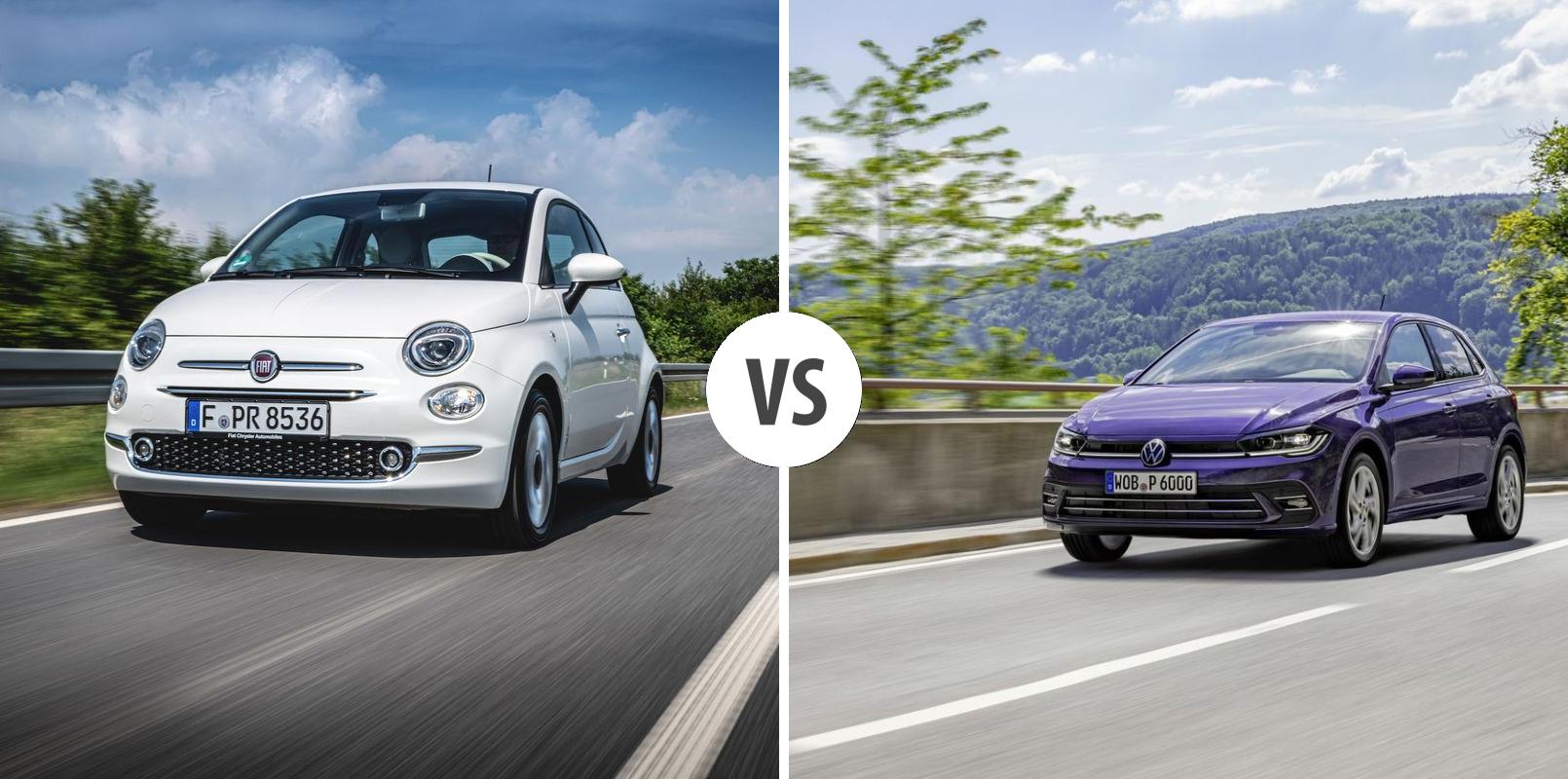
Italian style vs German reliability. We compare the numbers — space, running costs, insurance, and resale — to help you decide.
Search Our Stock ❯At first glance, comparing these two seems absurd. The Fiat 500 is a speciality city car — deliberately small, deliberately cute, deliberately unambitious. The VW Polo is a proper hatchback — a "grown-up" car that happens to be on the smaller end of the spectrum. They're competitors only by accident of price, not design philosophy.
Yet plenty of buyers face this exact choice. Both sit in overlapping price ranges second-hand. Both offer reasonable economy and practicality. But they're fundamentally different propositions. Let's examine why.
The Fiat 500 measures 3.546 metres. The VW Polo measures 4.053 metres — roughly 500mm longer. That's significant. Where the 500 prioritises nimbleness, the Polo prioritises space and maturity.
Boot space tells the story. The 500's 185 litres is tight. The Polo's 351 litres is more than double. For families, business users, or anyone needing to carry more than shopping bags, the Polo is in another league entirely.
Interior space is similarly skewed. The Polo offers comfortable space for four adults on a motorway journey. The 500 is intimate — the Polo is spacious. Taller drivers will notice the difference immediately. The Polo accommodates 6' 2" individuals; the 500 becomes restrictive above 5'10".
Rear seat comfort is more generous on the Polo, with better legroom for rear passengers. If you regularly carry passengers or plan to carry children and their equipment, the Polo is objectively more practical.
The Fiat 500 currently offers the 1.0 mild hybrid (70 bhp) or older 1.2 petrol (69 bhp). The VW Polo typically comes with 1.0 TSI turbocharged petrol (95-110 bhp depending on age and specification). The Polo is substantially more powerful and feels more responsive.
On motorways, the Polo is noticeably more capable. It maintains cruising speed with less effort. The turbocharged engine delivers more usable torque across the rev range. The 500 is perfectly adequate for city work but feels outmatched on sustained 70 mph driving.
Fuel economy is comparable when both are driven carefully (50-55 mpg possible on both), but the Polo's greater engine efficiency means it's less compromised by motorway use. The 500's efficiency figures are best achieved in city driving.
The Polo feels more substantial. Doors close with a satisfying thunk rather than a tinkle. The interior uses better materials across the board. Wind and road noise are better controlled. Controls feel more precise. The driving experience is more "proper car" and less "quirky runabout."
The Fiat 500's interior is charming but utilitarian. Harder plastics, cheaper trim materials, and less attention to acoustic refinement. The 500 prioritises character over sophistication; the Polo prioritises sophistication over character.
This matters if you spend significant time in the car. On a 45-minute commute, the Polo's refinement shines. On a 10-minute city hop, the 500's charm wins.
The Polo carries VW's engineering reputation. Turbocharged petrol engines require attention to servicing but are fundamentally sound. Parts are readily available and reasonably priced. The Polo typically proves more durable at higher mileage. A 150,000-mile Polo is unremarkable; the same on a 500 is noteworthy.
The Fiat 500 has improved significantly in recent years but carries historical reliability concerns. The modern 500 is fine, but the Polo still holds the engineering advantage. For buyers expecting to keep a car beyond 100,000 miles, the Polo is the safer bet.
A 2020-on Fiat 500 mild hybrid and a similar-age Polo normally both fall under the post-April 2017 VED system, whose standard annual rate is £200 in 2026/27. Compare the exact registrations, insurance quotes, fuel use, purchase price and service history.
Insurance groups favour the Fiat (1-11) over the Polo (16-24). Expect 30-40% cheaper insurance on the Fiat for equivalent drivers. Fuel economy is comparable when both are driven appropriately, though the Polo's greater highway capability might justify slightly higher running costs for motorway users.
Servicing costs are comparable — both are mainstream European cars with readily available parts. The Polo's turbocharged engine requires synthetic oil and might be marginally costlier per service.
The Fiat 500 is engineered for city driving. Light steering, playful suspension, and compact dimensions make threading through traffic enjoyable. It's engaging in town but reveals its limitations on open roads — understeer is apparent above 50 mph, and motorway manners are adequate but uninspiring.
The Polo is engineered for all-around competence. It's happy in cities but equally at home on motorways. The handling is more neutral, the steering more mature. It's not as entertaining as the 500 in tight urban spaces but substantially more versatile across different driving environments.
The Polo typically holds value better than the 500 — roughly 55-60% after three years versus 50-55% for the 500. Volkswagens appeal to a broader market, command stronger residual prices, and attract more potential buyers. The 500's niche appeal means tighter residual valuations.
That said, both are desirable in the used market at the right price point. Well-maintained examples of either age well, though the Polo's stronger residuals mean lower absolute depreciation.
Urban-Only Commuter: The Fiat 500. It's cheaper, more fun in cities, and better designed for that specific environment. If you rarely venture beyond city limits, the 500 is the smarter choice.
Mixed Commute (Town + Motorway): The Polo. Better motorway manners, more space for cargo, greater engine responsiveness at speed, and more suitable for longer journeys make it more versatile.
Small Family (with occasional rear passengers): The Polo. Significantly more practical, better luggage space, and superior child-seat accommodation make it the only sensible choice.
Budget Buyer Prioritising Lowest Running Costs: Compare the exact registrations. A pre-April 2017 500 may sit in a £20, £35 or higher CO₂ band, while post-April 2017 cars normally pay the £200 standard rate in 2026/27. Insurance, condition and servicing can outweigh the tax difference.
High-Mileage User: The Polo. Better suited to regular long-distance driving and showing greater durability at high mileage.
These aren't really competitors — they serve different audiences. The Fiat 500 is for people who prioritise character, affordability in cities, and the pleasure of something distinctly charming. The Polo is for people who need a practical, capable hatchback that happens to be smaller than alternatives.
If your driving is predominantly urban, the 500 is the more engaging and cheaper proposition. If you need genuine practicality, regular motorway use, or family-friendly space, the Polo is objectively the smarter purchase.
Choose the 500 for its personality. Choose the Polo for its sensibility. Neither is wrong — they're simply serving different customer profiles.
Sheffield's dedicated Fiat 500 specialists. 60+ years combined experience.
Browse Stock ❯