 🔍 Browse
🔍 Browse
🔍 Browse
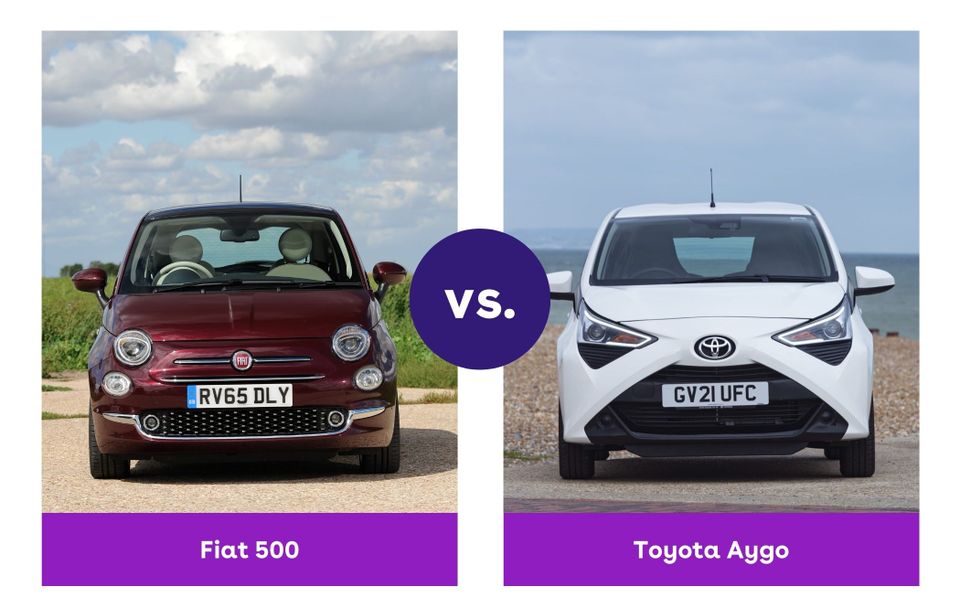
Two of the cheapest cars to run in the UK. We compare everything from insurance groups to boot space.
Search Our Stock ❯Both are purpose-built for city living. Both will run happily on a modest budget. Both are authentic alternatives to the mass-market hatchbacks that dominate Britain's roads. But the Fiat 500 and Toyota Aygo approach the challenge differently — one with Italian style, one with Japanese reliability.
If you're shopping in the sub-£10,000 bracket for a cheap, cheerful city commuter, these two repeatedly surface as the smartest buys. But which deserves a place on your driveway?
Both are genuinely small. The Fiat 500 measures 3.546 metres; the Toyota Aygo is slightly more modest at 3.465 metres. The difference is trivial — both excel at squeezing into tight urban parking. The real difference shows in interior accommodation.
The Fiat 500 offers 185 litres of boot space. The Aygo manages 168 litres — roughly 10% less. Not a huge gap, but if you regularly carry shopping bags, golf clubs, or travel with luggage, it's noticeable. The Fiat's interior feels slightly more spacious overall, though both are snug for rear passengers.
Head and shoulder room favour the Aygo marginally; it feels slightly airier despite being fractionally smaller. For pure cargo carrying, the Fiat wins. For overall interior ambience, it's marginal.
The current Fiat 500 typically uses the 1.0-litre mild hybrid (70 bhp) or the older 1.2 petrol (69 bhp). The Toyota Aygo comes exclusively with a 1.0-litre naturally aspirated three-cylinder petrol producing 72 bhp. On paper, they're virtually identical.
In practice, the Aygo feels marginally zappier. The VVTI variable valve timing adds a touch of refinement, and the engine feels fractionally more responsive. The Fiat's mild hybrid system helps efficiency more than it helps performance — perfectly adequate for city work, but neither is "sporty."
Fuel economy is comparable. The Fiat 1.0 hybrid achieves around 55-61 mpg combined. The Aygo manages 48-52 mpg. Both are adequate rather than exceptional. The Fiat's mild hybrid edge gives it a slight efficiency advantage.
Here the Aygo has a substantial reputation advantage. Toyota's reliability is legendary — the Aygo uses a robust, simple engine design with decades of proven engineering. Parts are inexpensive; every Toyota dealer stocks common items.
The Fiat 500 has improved considerably in recent years, but it carries historical baggage regarding reliability. The modern 500 is sound, but the Aygo still carries the Toyota badge of dependability. For buyers prioritising peace of mind, the Aygo is the safer choice.
Interior quality favours the Fiat. The 500's cabin is charming and well-appointed for the price, with attractive trim options and decent materials. The Aygo's cabin is more utilitarian — hard plastics, basic controls, minimal frills. The Fiat feels more upmarket.
Both sit in lower insurance groups, but the Aygo typically occupies group 2-3 versus the 500's groups 1-11. In reality, both are very cheap to insure — expect quotes in the £300-£500 annually range for a young driver on either.
Road tax does not automatically favour the 2020-on mild hybrid. Cars first registered from April 2017 normally pay the standard annual VED rate, which is £200 in 2026/27. Compare the exact registrations, insurance, fuel use, purchase price and service history.
Maintenance costs favour the Aygo slightly. Toyota parts are often cheaper, servicing is available everywhere, and there are fewer electronic systems to fail. Both are cheap to run, but the Fiat's slightly lower tax just about balances things.
The Fiat 500 is designed to feel Italian — light steering, playful suspension, sense of connection. It corners with enthusiasm and feels "nicer" to drive. The steering wheel communicates what the front wheels are doing.
The Aygo prioritises simplicity and reliability over engagement. The steering is light but less communicative. The suspension is forgiving but less fun. It drives like what it is — a practical city tool. Nothing wrong with that, but it's less entertaining.
For daily commuting, both are fine. For weekend drives where you want to enjoy the journey, the Fiat is objectively more fun. The Aygo is more honest about what it is.
The Aygo typically depreciates slightly slower than the 500 — that Toyota reliability factor again. A three-year-old Aygo might retain 50-55% of its original value; a 500 might be at 48-52%. The gap is small, and the Fiat's lower purchase price means absolute depreciation is often similar.
Both hold value reasonably well in the used market. Budget-conscious buyers seeking affordable transport mean demand stays steady for either.
The fundamental difference is philosophical. The Fiat 500 is style-led. It's cute, charming, and distinctly un-Japanese. Every detail is designed to appeal to the eye and heart. It's a car for people who care about how their commute feels.
The Aygo is substance-led. It's practical, reliable, and thoroughly engineered to do one job well — transport you affordably and without drama. It's a car for people who care about getting from A to B without thinking about it.
First-Time Buyer with Budget Constraints: The Aygo. Toyota reliability, low servicing costs, and straightforward ownership mean fewer surprises. You can't go wrong with an Aygo.
Style-Conscious City Dweller: The Fiat. It makes you smile every time you walk towards it. The driving experience is more engaging. You're buying character alongside transport.
High-Mileage Commuter: The Aygo. That Toyota engine will rack up 150,000 miles without complaint. It's more suited to constant daily use.
Weekend Driver / Enthusiast: The Fiat. The 500 is more entertaining, more engaging, and more interesting. You'll enjoy the journey, not just endure it.
Choose the Aygo if you want maximum reliability, zero fuss, and predictable ownership. You're buying engineered simplicity and Toyota's legendary dependability. It's the sensible choice.
Choose the Fiat 500 if you want a car with personality, character, and the pleasure of something beautifully designed. You're buying style alongside transport. Ownership might require slightly more attention, but rewards you with a more engaging daily drive.
Neither is objectively wrong. Your choice depends on whether you value peace of mind or driving pleasure more highly. Both will serve an urban commuter well.
Sheffield's dedicated Fiat 500 specialists. 60+ years combined experience.
Browse Stock ❯