 🔍 Browse
🔍 Browse
🔍 Browse
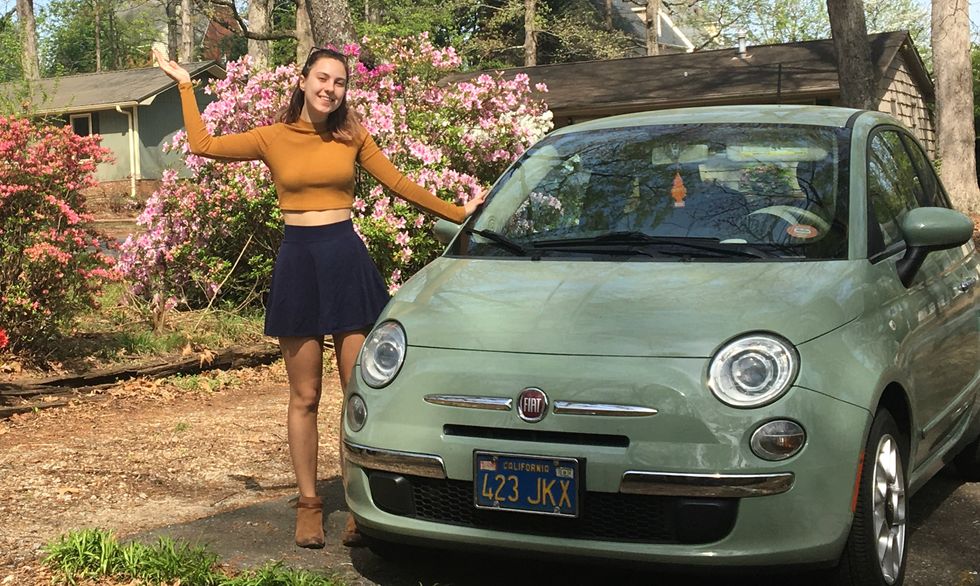
Light controls, excellent visibility, tight turning circle, and low insurance. Here's everything learner drivers and their parents need to know.
Search Our Stock ❯At Fiat 500 Frenzy, we're Sheffield's only dealership dedicated exclusively to the Fiat 500. With over 60 years of combined motor trade experience, Tom and Shane have the expertise to guide you through every aspect of Fiat 500 ownership. Whether you're buying, selling, or just researching, we're here to help — no pressure, just honest advice from people who genuinely love these cars.
Driving instructors across the UK have made the 500 their vehicle of choice. Not because it's sporty (it isn't), but because it's exceptionally practical for teaching. The compact dimensions create lower-stress learning environments: tight urban streets that intimidate learners in larger cars feel manageable in a 500. Car parks transition from anxiety-inducing to doable. The direct steering, responsive engine (69 bhp is ample but not tempting), and light clutch make progression smooth. Visibility is excellent; the upright driving position gives learners a commanding view of surroundings. The controls are intuitive and unthreatening—no complex automated systems to confuse technique, just straightforward mechanical feedback that teaches proper braking and acceleration anticipation. From an instructor's perspective, the 500 is safer than high-powered cars (no temptation to accelerate recklessly) and more rewarding than larger, anonymously-styled cars (learners feel they're driving something with character and purpose).
Most driving schools source 1.2-litre petrol manual examples (2010-2015 preferred). The specs are consistent: safety equipment includes dual airbags (standard), ABS, electronic stability control, and—on newer examples—traction control. The manual transmission is essential; automatics would skip the gear-selection learning process. The five or six-speed manual (depending on year) has a light, progressive clutch that novices master relatively quickly. Insurance for a school car (typically higher risk than private driving due to exposure) is incorporated into lesson pricing; schools negotiate fleet rates considerably lower than young drivers pay. Fuel consumption in stop-start driving (typical of lessons) is roughly 35-45 mpg; schools accept this as normal. Maintenance intervals on school vehicles are strict (often every 3,000 miles or monthly service) because high utilisation (multiple lessons daily) creates wear. A well-maintained school 500 will have 150,000+ miles logged without serious mechanical issues; instructors simply track maintenance meticulously.
Learner drivers experience acute spatial anxiety. The smallest cars—the 500 (3.6m long) alongside the Aygo and Up—alleviate this dramatically. The 500's tight turning circle (8.6 metres) makes three-point turns in narrow streets achievable without excessive reversing. Parallel parking, a frequent test manoeuvre, becomes manageable when the car isn't 4.2 metres long (like a Corsa) or 4.5+ metres (like a Golf). Learners can park in spaces they'd never attempt in larger cars, building confidence quickly. Kerb awareness develops faster because the 500's narrow track (1.6m wide) gives precise feedback; hitting a kerb in a 500 teaches the lesson more dramatically than in a wider car. The proportions encourage learners to feel the car rather than estimating position. Instructors report that learners spending 20 hours in a 500 develop better spatial awareness than 20 hours in a larger car; the car becomes an extension of their body awareness, not an abstract machine.
The 69-bhp 1.2 petrol is the Goldilocks engine: powerful enough to merge motorways safely (0-60 in roughly 11 seconds; 120 mph top speed), not so powerful that it tempts rash decisions. Learners cannot accidentally overwhelm the car's grip with aggressive acceleration; the engine's power is always proportional to their input. There's no turbo lag or unexpected surge; throttle response is linear and immediate, making throttle modulation intuitive. Fuel consumption feedback is excellent (45-50 mpg for smooth driving, dropping visibly if aggressive—immediate feedback of driving style). Compared to turbocharged engines (which introduce lag and then surge), the naturally-aspirated 1.2 teaches immediate cause-and-effect driving. Diesel alternatives (available on some 500 school cars) have excellent torque but can be less linear; petrol is pedagogically superior for learners because it forgives and encourages smooth technique.
The manual gearbox teaches systematic driving: checking mirrors, signalling, assessing road conditions, selecting the appropriate gear, then accelerating. This methodical process embeds proper driving culture. Smooth gear changes require coordinated throttle and clutch control, developing multi-limb coordination. The learner experiences direct mechanical feedback (grinding gears if rushed, smooth progress if patient), making technique instantly rewarding. Modern automatics and CVTs bypass this learning; drivers can concentrate on steering and road awareness, but they miss the mechanical understanding of how engines and transmissions interact. By the time a learner has passed their test and driven a 500 manual for months, they've internalised smooth gear changes, throttle control, and braking anticipation—skills that transfer to any car. A learner who passes in an automatic often struggles when borrowing a manual (or borrowing dad's 25-year-old Golf with a stiffer clutch). The 500's light, forgiving manual is the optimal learning ground.
The 500's upright driving position offers a commanding view of surroundings. The windscreen is large and vertical (not raked like modern SUVs), giving clear sightlines to pedestrians and cyclists. The side windows are large; learners can see door-zone hazards clearly. The wing mirrors are positioned for excellent view of adjacent lanes (critical for safe overtaking or lane changing). The small overall footprint means blind spots are minimal; what a learner can't see directly, they can reasonably infer is clear. Modern cars with sloped rooflines, thick A-pillars, and massive blind spots create danger for inexperienced drivers; the 500's design mitigates this. Safety is passive (no electronic nannies doing the thinking) and active (excellent visibility and feedback). Learners in 500s develop superior road awareness because they must constantly scan and assess; the car doesn't do the scanning for them (as modern stability systems partially do).
The 500's lightweight platform (900 kg) and short wheelbase (2.3m) create nimble, responsive handling. The power steering is light but communicative; learners feel what the front tyres are doing. The suspension is compliant enough for comfort but firm enough to provide feedback; learners can sense when they're nearing the limits of grip (tyre squealing at cornering limit is immediate feedback). Body roll in corners is noticeable (not a sports car), but it's actually beneficial for learners: the car's movement communicates its state. A learner senses the 500 leaning into a corner and instinctively eases off the throttle—good driving behaviour. There's no artificial electronic nanny intervening; the learner learns to drive smoothly by feeling the car's responses. Contrast this with modern stability-controlled cars where learners can corner aggressively without feedback; they never learn the limit because the car hides it. The 500 teaches genuine vehicle control.
Dual controls: Driving school 500s have dual brake and clutch pedals (instructor's set on left side). This allows the instructor to intervene safely if a learner makes a critical error. The mechanical simplicity of the 500 makes fitting dual controls straightforward. Noise: The 500 is moderately loud at motorway speeds (69 db); instructors can communicate with learners in normal conversation. Seating: Four-seat configuration (with one side bench for passenger) means the instructor sits beside the learner; direct observation and verbal feedback are easy. Fuel consumption: At lesson rates (mixed urban/motorway), refueling is needed every 2-3 days of intensive use. Cost is roughly £40-50/day. Climate control: Air-con and heater are adequate; learners are comfortable year-round. Durability: The 500's robust construction handles intensive use (40,000+ miles/year for school cars) without structural fatigue. Wear items (brakes, tyres, clutch) are predictable and budgetable.
Learner drivers (L-plate holders) must drive with a qualified instructor or supervising adult (minimum 21 years old, minimum 3 years' driving experience). They cannot drive on motorways. Insurance for learner driving lessons is complex: if using a school vehicle, insurance is covered by the school's fleet policy (already accounted for in lesson cost). If using a private 500 for supervised practice with a parent/guardian, the car must be insured for that purpose (most comprehensive policies permit it; declare to the insurer). Once a learner passes their test and becomes a young driver (17-25 age bracket), they shift to learner-driver insurance (1-2 year restrictions: no motorways for first six months, lower speed limits, possibly curfew). The 500's low insurance groups (1-3 for 1.2 Pop) mean young-driver insurance premiums are minimised—a significant advantage against larger hatchbacks where groups 6-8 add £200-400/year.
Many learners progress to owning their own 500 after passing tests. The car they learned in (2012-2015 1.2 manual, typically) costs £4,000-5,000 secondhand—affordable without external financing. They know the car intimately (every button, every handling characteristic), making transition to ownership smooth. Fuel costs remain reasonable (£30-40/week for urban driving). Insurance drops dramatically once they reach claim-free driving history (from £800+/year as a learner-driver to £200-300/year by age 25 with clean record). The 500 transforms from learning tool to confident ownership vehicle; many young drivers keep their 500 for 3-5 years, then upgrade to larger cars. The transition from supervised learning to independent driving is psychologically eased by continuing in the familiar, characterful 500.
Learners appreciate the 500's manageable size and excellent visibility, building confidence quickly.
Sheffield's dedicated Fiat 500 specialists. 60+ years combined experience.
Browse Stock ❯