 🔍 Browse
🔍 Browse
🔍 Browse
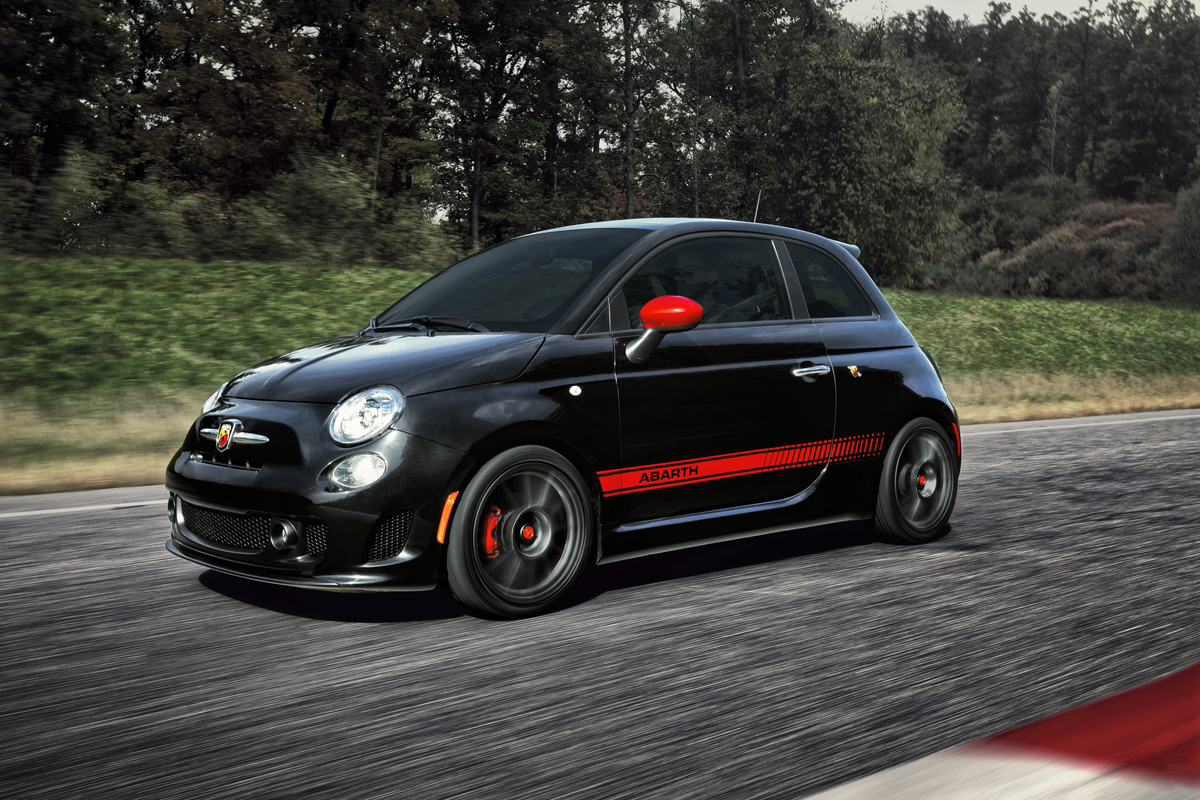
The hot hatch version of the Fiat 500. Turbocharged 1.4-litre engine, sport exhaust, lowered suspension, and that iconic Scorpion badge. From the 135bhp base model to the 180bhp 695.
Search Our Stock ❯The Abarth 500 is the hotter version of Fiat's iconic city car. With a 1.4-litre turbocharged T-Jet engine, lowered and stiffened suspension, and the unmistakable Scorpion badge, it's designed for drivers who want proper performance without the complexity of a larger hot hatch. This is raw, accessible fun—a proper hot hatch for those who appreciate character over horsepower numbers.
All Abarth 500s use a 1.4-litre turbocharged petrol engine codenamed T-Jet. In its base form (2008-2014), it produces 135 bhp and 152 lb-ft of torque, hitting 62 mph in a respectable 7.9 seconds. From 2014 onwards, a revised version pushed the base power to 145 bhp with the same torque, cutting acceleration to around 7.5 seconds. The top-spec Abarth 695 (introduced 2013) delivers 180 bhp and 209 lb-ft, cracking 62 mph in 6.7 seconds.
The turbo unit itself is a Magneti Marelli-sourced component, proving durable when serviced correctly. Fuel consumption sits around 40-48 mpg combined on the official figures, though real-world driving (especially in sport mode) typically sees 35-40 mpg. Emissions are managed by a catalytic converter and particulate filter system.
The Abarth lineup splits into distinct tiers. The **Abarth 500** base (135-145 bhp) is the purest expression—stripped-back, lightweight, and focused. The **Abarth 595** (145-165 bhp) arrived in 2012 as the mid-range option, adding equipment like cruise control, better sound insulation, and modern conveniences while retaining the performance edge. The **Abarth 695** (180 bhp) is the flagship—limited edition runs, Brembo braking systems, Koni FSD adjustable dampers, mechanical limited-slip differential, Sabelt racing seats, and more aggressive styling. Special 695 editions (Tributo Ferrari, Biposto, 70th Anniversario) carry premium values.
For used buyers, the distinction matters. A 595 offers better daily usability than a stripped 500, while a 695 commands respect and resale value but costs considerably more and may require more maintenance if modified.
Abarths use a specially tuned suspension setup that lowers the car by 10mm compared to the standard Fiat 500. Spring rates are increased by 15% front and rear, damping rates similarly raised. This creates a noticeably tighter, more responsive chassis—cornering feels planted without sacrificing the inherent ride comfort of a city car. Brake dive is well-controlled, and body roll is minimal.
Brakes vary by model. Base 500/595 models use Brembo single-piston sliding calipers (capable and reliable). The 695 upgrades to four-piston fixed calipers with larger rotors (330mm front vs 290mm on base models), offering superior stopping power and fade resistance—genuinely useful for track days. All models use ventilated front discs.
The mechanical differential on 695 models is a clever touch—it allows power to be vectored to the wheel with the most grip during hard cornering, reducing understeer and sharpening turn-in. Standard models use an open diff, which can cause torque steer in hard acceleration, though the relatively modest power keeps this manageable.
The signature Abarth characteristic is the exhaust note. All versions get a Record Monza exhaust system—stainless steel, dual-exit, and tuned to unleash a distinctive crackle and pop. Gear changes produce gunshots on the overrun, and the engine carries a mechanical growl that sounds genuinely Italian. It's one of the reasons people buy Abarths. If a quiet daily commute is the goal, the 500/595 might disappoint on sound alone, though it's still relatively civilised inside the cabin.
Abarth interiors reflect the brand's racing pedigree. Sport seats with aggressive side bolstering come as standard (leather-trimmed on some years), wrapped in Alcantara or suede steering wheels on higher specs. Pedals are typically aluminium alloy. The instrument cluster uses white-on-black dials with red Abarth branding. Equipment levels vary by age—older models lack climate control and decent infotainment, while 2013+ units incorporate modern conveniences like an 7-inch touchscreen, Bluetooth, and integrated reversing cameras.
Practical storage is honest rather than generous. The 185-litre boot is adequate for weekend bags and shopping, but it's not a road trip car. The rear bench seats split 60/40 and fold flat, expanding capacity to around 600 litres.
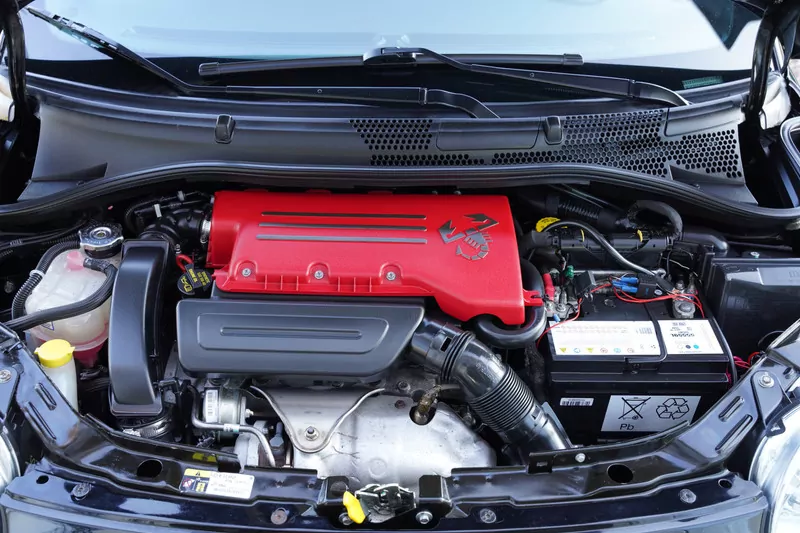
The iconic Scorpion badge identifies the Abarth, while the Record Monza exhaust system delivers the legendary soundtrack.
The 1.4 T-Jet engine has a solid reputation. Main failure points to check when buying: turbocharger health (listen for whistle on acceleration or loss of boost pressure), service history (critical on turbos), and clutch condition. Hard-driven examples may have worn clutches—replacement costs around £800-1,200. Carbon buildup on the intake valves can occur after 60,000 miles, potentially affecting cold starts. Removing and cleaning valves is a common maintenance task on high-mileage units.
Age, use and modification history all affect an Abarth's condition. Inspect the charging system, suspension, brakes and cooling system carefully. Brake fluid is normally replaced every two years. The 1.4 T-Jet is belt-driven, so follow the age and mileage interval in the handbook for the exact car and check for dated replacement evidence.
Parts are inexpensive relative to other hot hatches—Abarth shares platforms with Fiat, so many consumables (pads, filters, fluids) are affordable. Specialist Abarth parts (exhaust components, suspension upgrades) are readily available through dealers and online importers.
Insurance is genuinely the pain point. Group 25-35 depending on model and modifications means expect £1,200-2,500 annually for a young driver, £600-1,200 for someone over 30 with clean history. This significantly exceeds a standard Fiat 500 (group 6-11). Most insurers load the premium because of the turbocharged nature and perceived modification risk—many Abarths are modified, which raises claims costs across the range.
Road tax depends on first registration and recorded CO₂. For 2026/27, pre-April 2017 Abarths use their CO₂ band, while most later cars pay the £200 standard rate. Fuel, tyres, brakes and servicing also vary greatly with condition and use, so price the exact car rather than relying on a range-wide estimate.
A 695 with 180 bhp feels faster than the figures suggest. The lightweight chassis (around 1,035 kg), turbo's instant response, and short wheelbase mean real-world acceleration feels properly quick, especially up to 50 mph. Beyond 80 mph, the power falls away slightly as you hit the turbo's plateau. Compared to a Volkswagen Up GTI (115 bhp) or Mini Cooper (102 bhp), the Abarth feels substantially quicker—better power delivery and a more athletic setup make the difference.
Handling is genuinely impressive for a city car. The lowered, stiffer suspension makes cornering confidence-inspiring without feeling brittle. Body control is excellent. Only at the absolute limit does the front-wheel-drive layout show understeer, and even then it's progressive and manageable. For spirited driving on B-roads, the Abarth punches far above its weight.
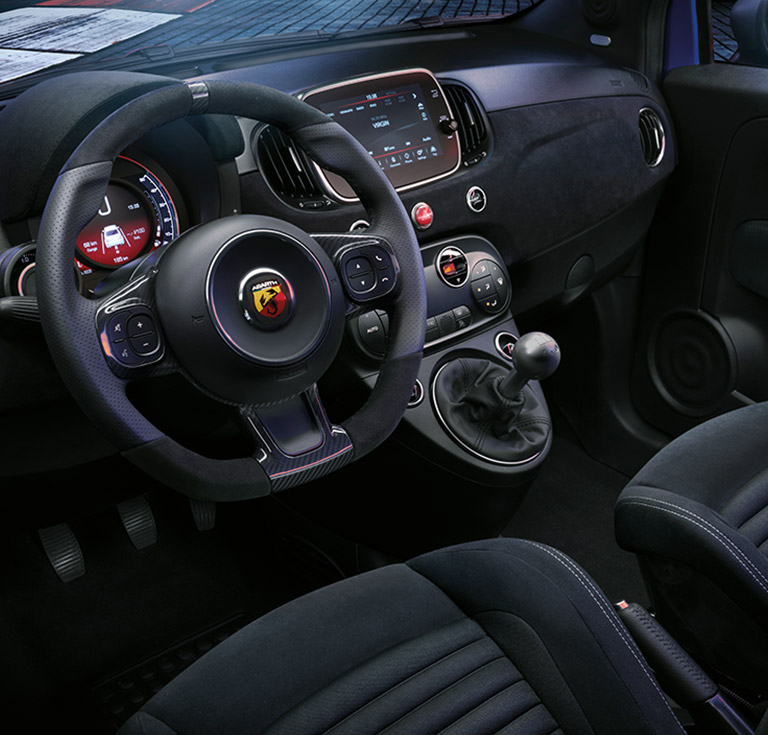
Sport seats with aggressive bolstering and an Alcantara steering wheel set the racing tone inside.
Abarths occupy a unique niche. They're too loud and unrefined for those wanting a practical city car, too small for family duties, but far cheaper than a full-fat hot hatch like a Ford Fiesta ST or Renault Clio RS. For driving enthusiasts with modest budgets, they're brilliant value. They're also beloved by tuners—bolt-on turbo upgrades pushing 200+ bhp are common and relatively affordable.
The Abarth 500's character is divisive: some find the exhaust note intoxicating and the handling enthralling; others find it a gimmicky, noisy toy. There's little middle ground. If you appreciate character, rawness, and accessible performance with a racing soundtrack, it's compelling. If you want efficiency, refinement, and understated speed, look elsewhere.
Abarth 500 buyers should prioritize these checks:
We source and stock Abarths across all power outputs. Tell us what you want.
Search Our Stock ❯